live_tv
Livestream Starting Soon
00
Hours
:
00
Minutes
:
00
Seconds
Up next in 10


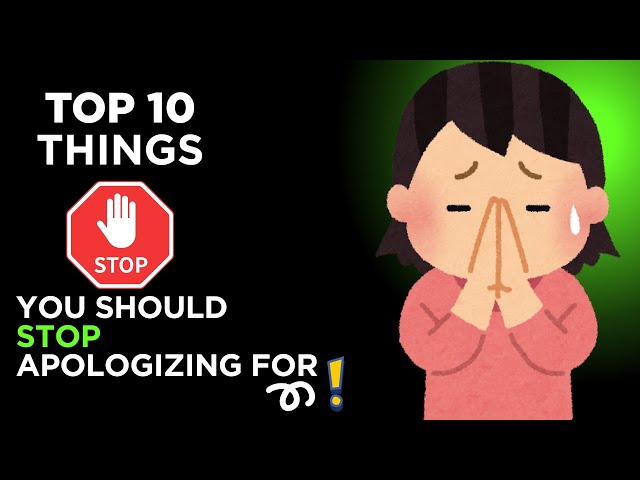
Apologizing is a sign of empathy and respect, but many people overdo it — apologizing for things they shouldn’t, feeling guilty unnecessarily, or putting others’ comfort above their own. Over-apologizing can hurt your confidence, your image, and how people perceive you.
In this video, we reveal the top 10 things you should stop apologizing for, from expressing your opinions and saying “no” to taking up space and prioritizing your needs. By letting go of unnecessary guilt and standing firm in your boundaries, you can boost confidence, self-respect, and personal empowerment.
Watch till the end — the final point is subtle but life-changing, and it can instantly help you feel more confident and unapologetically yourself.
Show More Show Less View Video Transcript
0:00
Hello, welcome to our channel, Top 10s
0:03
You Should Know. Today, we're tackling a
0:05
subtle habit that can quietly erode
0:07
self-confidence and professional
0:09
presence. Over apologizing.
0:12
Apologizing is important when you truly
0:14
make a mistake, hurt someone, or cross a
0:16
line. But unnecessary apologies for
0:20
being assertive, for expressing your
0:21
opinion, or for having needs can make
0:24
people undervalue you and even question
0:26
your authority. By understanding what
0:28
not to apologize for, you'll strengthen
0:30
your confidence, your communication, and
0:32
the way others perceive you. Let's dive
0:34
into the top 10 things you should stop
0:36
apologizing for.
0:39
One, for expressing your opinion. Your
0:41
thoughts, ideas, and perspectives are
0:43
valid, and you don't need to say sorry
0:45
for them. Expressing your opinion
0:48
respectfully demonstrates confidence and
0:50
individuality. Constantly apologizing
0:53
for sharing your perspective signals
0:55
self-doubt and can make others
0:57
unconsciously devalue your input.
0:59
Intelligent, assertive individuals
1:02
communicate their ideas without fear of
1:03
judgment, and that inspires respect
1:06
rather than resentment.
1:08
Expressing your opinion, even when it
1:09
differs from the majority, demonstrates
1:11
courage, confidence, and independent
1:14
thinking. Intelligent people don't shy
1:17
away from honest dialogue. They
1:19
communicate their perspectives
1:20
respectfully, supporting them with
1:22
reasoning or experience. And they
1:24
understand that disagreement isn't
1:26
disrespect. It's a natural part of
1:29
discussion. By stopping unnecessary
1:31
apologies for your opinions, you
1:33
reinforce your voice, strengthen your
1:35
influence, and create space for
1:37
meaningful dialogue over time. And
1:40
refraining from unnecessary apologies
1:42
for your opinions builds mental
1:44
resilience, improves self-respect, and
1:46
signals to others that your voice
1:48
matters. Instead of weakening your
1:50
presence with constant, I'm sorry, speak
1:53
with calm conviction and let your ideas
1:56
be heard. People will notice,
1:58
appreciate, and even admire your
2:00
willingness to contribute authentically.
2:02
For two, for setting boundaries.
2:05
Boundaries protect your time, energy,
2:07
and mental health. and you don't need to
2:09
apologize for them. Saying, "I'm sorry,
2:11
but I can't." Or, "I'm sorry for saying
2:13
no," diminishes your authority and makes
2:16
your boundaries seem negotiable.
2:18
Assertive people communicate limits
2:20
clearly and kindly without feeling
2:22
guilty. When you stop apologizing for
2:24
boundaries, you command respect,
2:26
maintain healthy relationships, and
2:28
prevent burnout. Boundaries are not
2:30
selfish. They're essential, and stopping
2:33
unnecessary apologies reinforces your
2:36
self-worth.
2:37
Three, for taking up space. Whether it's
2:40
in a conversation, a room, or a
2:41
professional setting, taking up space is
2:43
your right, and it's a sign of
2:45
confidence. People often apologize for
2:48
speaking louder, moving freely, or
2:50
claiming attention. But you shouldn't.
2:53
Standing tall, expressing yourself
2:55
fully, and existing unapologetically
2:57
signals presence and self asssurance.
3:00
When you stop apologizing for taking up
3:02
space, others perceive you as confident,
3:05
assertive, and deserving of recognition.
3:07
This habit not only changes how others
3:09
perceive you, but also how you perceive
3:11
yourself, reinforcing self asssurance,
3:14
mental clarity, and emotional balance.
3:16
Over time, you'll notice that
3:18
unapologetically existing in your own
3:20
space inspires respect and admiration
3:22
simply because it signals authenticity
3:25
and selfrespect. Four, for asking for
3:28
help. Seeking assistance doesn't make
3:30
you weak, and apologizing for it can
3:32
make you seem insecure. Everyone needs
3:34
help sometimes. It's human. Saying, "I'm
3:37
sorry for bothering you," or "I hate to
3:39
ask," undermines your dignity.
3:41
Assertive, admired people ask for help
3:43
clearly and respectfully, acknowledging
3:45
that collaboration benefits everyone.
3:48
Stopping unnecessary apologies here
3:50
strengthens relationships, improves
3:52
efficiency, and shows you value your own
3:54
needs as much as others. Five, for
3:58
making mistakes. Yes, you should
4:00
apologize for mistakes when they impact
4:02
others significantly, but not every
4:04
minor error requires an apology. Over
4:07
apologizing for small slip-ups signals
4:09
low confidence and self-criticism.
4:11
Intelligent people acknowledge errors
4:13
internally, learn, adjust, and move
4:16
forward without excessive apologies.
4:18
This approach demonstrates maturity,
4:20
accountability, and emotional
4:22
resilience, which are far more admirable
4:24
than constant remorse. Apologizing for
4:27
every slip can unintentionally reduce
4:30
your credibility because people may
4:31
perceive you as overly sensitive or
4:33
unsure. This approach communicates
4:36
resilience, accountability, and self
4:38
asssurance. By reserving apologies for
4:40
meaningful situations, you demonstrate
4:43
maturity, and composure. People will
4:45
admire your ability to take
4:46
responsibility gracefully without
4:48
allowing minor errors to undermine your
4:50
presence or confidence. Embrace mistakes
4:53
as natural and let your reactions, calm,
4:56
thoughtful, and solutionoriented, speak
4:58
louder than words. Six, for saying no.
5:01
No is one of the most empowering words
5:04
and apologizing for it can dilute its
5:06
strength. People who over apologize when
5:09
declining requests often invite
5:11
pressure, manipulation or resentment.
5:13
Assertive individuals state no clearly
5:16
and respectfully without adding
5:18
unnecessary guilt. This approach
5:20
communicates boundaries, clarity, and
5:22
confidence. And over time, others learn
5:24
to respect your decisions without
5:26
needing excuses or apologies. Seven, for
5:29
being yourself. Your personality,
5:31
quirks, and unique traits make you who
5:33
you are, and you should never apologize
5:35
for being yourself. People who
5:37
constantly apologize for their natural
5:39
behaviors come across as insecure or
5:42
unsure. Admired individuals embrace
5:44
authenticity unapologetically, inspiring
5:47
others to do the same. When you stop
5:49
apologizing for simply existing, you
5:51
radiate confidence, attract respect, and
5:54
set the standard for genuine
5:55
interactions. Eight, for your success or
5:58
achievements. There's no need to
6:00
apologize for working hard, succeeding,
6:03
or achieving goals. Over apologizing for
6:06
accomplishments makes others undervalue
6:08
your efforts. Admired individuals
6:10
celebrate successes with humility, but
6:12
without guilt. Sharing achievements
6:15
inspires, motivates, and communicates
6:18
capability. By refraining from
6:20
apologizing for your accomplishments,
6:22
you assert your competence and
6:23
demonstrate confidence that naturally
6:25
commands respect.
6:27
Success is not a competition or a reason
6:29
to feel guilt. It is proof of your
6:31
discipline, resilience, and strategic
6:33
effort. By stopping unnecessary
6:35
apologies for your achievements, you
6:37
assert your competence, command respect,
6:39
and set an example for those around you
6:41
that ambition and accomplishment are to
6:43
be celebrated, not hidden. Your success
6:46
can inspire, elevate, and create
6:48
opportunities unapologetically.
6:51
Nine, for taking time for yourself.
6:53
Self-care is essential and you shouldn't
6:56
apologize for prioritizing it. Taking
6:58
breaks, resting, or pursuing personal
7:01
interests is healthy and necessary.
7:03
People who apologize for self-care often
7:06
appear overcommitted, stressed, or
7:08
insecure.
7:09
Setting aside time without guilt
7:11
demonstrates self-respect, discipline,
7:13
and emotional intelligence. Others will
7:16
admire your ability to balance
7:18
responsibilities while maintaining
7:19
personal well-being. 10 for your
7:22
emotions.
7:23
Finally, you don't need to apologize for
7:25
feeling what you feel. Whether joy,
7:27
sadness, frustration, or excitement,
7:30
emotions are valid and natural. Over
7:32
apologizing for expressing feelings can
7:34
stifle authenticity and communication.
7:37
Intelligent, admired individuals
7:39
acknowledge emotions respectfully,
7:41
express them appropriately, and navigate
7:44
interactions without unnecessary guilt.
7:46
By honoring your feelings without
7:48
apology, you demonstrate self-awareness,
7:50
courage, and emotional maturity. traits
7:53
that naturally earn respect and
7:54
admiration. And there you have it, 10
7:57
things you should stop apologizing for.
8:00
Remember, apologies are powerful when
8:02
used genuinely, but unnecessary
8:04
apologies dilute your confidence,
8:06
credibility, and presence. Start
8:09
practicing restraint in saying, "I'm
8:11
sorry." And notice how people begin to
8:13
see you as more confident, assertive,
8:15
and self assured. What's your opinion?
8:18
Let us know in the comments.